By Erika Mae P. Sinaking and Kenneth Christiane L. Basilio, Reporters
THE Philippine government is seeking additional fuel suppliers to help stabilize domestic supply as global oil markets remain volatile, President Ferdinand R. Marcos, Jr. said on Wednesday.
“We are talking to many other countries who we normally do not buy oil from,” Mr. Marcos told a livestreamed briefing from New York City.
He said the government hopes to reach agreements that would allow the Philippines to secure additional fuel shipments and diversify its sources of supply.
The President said the country’s fuel inventory remains sufficient for now, with stocks available locally and more shipments already on the way.
“In terms of supply, we are in good shape,” he said. “Not only do we have inventory in the Philippines, we also are awaiting some supplies coming in that are in transit.”
Authorities are monitoring the incoming shipments to ensure they do not pass through high-risk areas, Mr. Marcos added, noting that the possible closure of the Strait of Hormuz has not yet been factored into the country’s supply outlook.
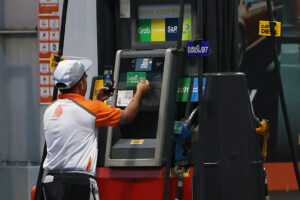
Despite stable supply expectations, domestic consumers are already facing higher fuel costs as global oil prices push pump prices upward.
The Department of Energy said kerosene prices could reach P122.67 per liter by March 12 after a cumulative increase of P36.
Diesel prices are expected to settle at about P84.75 per liter following a total hike of P24.25 over three days, while gasoline Ron 91 may rise to around P60.85 per liter.
The adjustments are part of a series of staggered increases announced for the week of March 10 to 16 as local fuel retailers respond to higher international oil prices.
“We are trying to keep prices down, but there is an inevitable effect,” Mr. Marcos said. “When oil goes up, everything goes up.”
Global crude prices recently climbed above $100 per barrel before easing to below $90, he added, noting that uncertainty remains over how long the Iran war will last and how long prices will stay elevated.
Because higher fuel costs feed into the prices of goods and services, the President said the government is seeking emergency powers from Congress that would allow it to intervene if global oil prices remain above $80 per barrel for an entire month.
Possible measures include suspending excise taxes on petroleum products and expanding subsidies for sectors most affected by rising energy costs.
The government’s fuel subsidy program is expected to roll out next week, authorities said, as the government tries to cushion the impact on public transport operators and other vulnerable sectors.
‘NOT NORMAL’
Transport groups said they might hold off on requesting fare increases if the government proceeds with tax relief and financial assistance.
Jeepney drivers are already losing P400 to P500 a day because of higher fuel costs, according to Mar S. Valbuena, chairman of transport group Manibela.
“The increase in petroleum products is not normal,” he told lawmakers at a hearing in the House of Representatives. “If this rise in fuel prices continues, we may lose even more of our income.”
Drivers typically earn about P800 a day, meaning the latest price increases are cutting deeply into their take-home pay, he added.
Fuel retailers have raised pump prices several times this year as global oil costs climbed. This week’s adjustments, ranging from P7 to as much as P38.50 per liter, mark the 11th straight increase for diesel and kerosene and the ninth for gasoline.
Mr. Valbuena said transport groups could request a P2 fare increase but described it as a last resort because higher fares could trigger broader inflation.
“Requesting a fare increase is our last resort,” he said, urging lawmakers to quickly approve a measure that would allow the government to suspend excise taxes on fuel so drivers can retain more of their earnings.
Other transport groups echoed the concern. Orlando Marquez, Sr., national president of the League of Transportation Operators of the Philippines, said operators have long sought fare adjustments to offset rising operating costs.
Meanwhile, George Jalandoni, president of the UV Express Association, said shuttle van operators should also be included if authorities decide to raise public transport fares.
“I hope that UV Express vans will be included in the fare increase,” he told lawmakers, noting that operators are also struggling with higher fuel expenses.
Officials from the Land Transportation Franchising and Regulatory Board said the agency is reviewing several pending fare petitions.
Greg G. Pua, Jr., a board member of the regulator, told lawmakers that authorities would act quickly if fare adjustments become necessary.
“Almost all of them have pending petitions,” he said. “We assure [everyone] that we will act immediately and leave no one behind.”
Arsenio M. Balisacan, head of the Department of Economy, Planning, and Development, on Tuesday warned that inflation could accelerate to as much as 5.1% this month as higher oil prices raise transportation and logistics costs across the economy.
previous post
