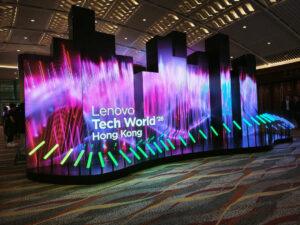
In a period defined by the rapid adoption of artificial intelligence across several industries, Lenovo has outlined its initiatives for a global AI deployment at Lenovo Tech World ‘26 Hong Kong. Held last March 10, the flagship event brought together Lenovo’s real-world AI-powered projects.
Moving from conceptual and basic implementation of AI, Lenovo presented its AI-driven strategy across several industries from consumer to industrial applications with equal focus on hardware and software that powers them. Through a series of keynote speeches, panel discussions, media roundtables, and experiential exhibits, Lenovo demonstrated its innovations with its Hybrid AI framework which integrates Personal AI, Public AI, and Enterprise AI.
WELCOME AND OPENING KEYNOTES
For his welcome keynote, Ken Wong, Lenovo Executive Vice President and President, Solutions & Services Group, said that AI has gone beyond just being a search tool. It can now reason and act in real time.
“For enterprises, this marks a new phase, where AI turns data into action, connecting digital and physical worlds,” Mr. Wong said.
“At Lenovo, this is how we bring AI to you: personal AI across devices and enterprise AI across value chains. Together, we call this Hybrid AI.”
As a framework, Hybrid AI considers the present reality that individuals and organizations have different demands when using artificial intelligence. There’s no one-size-fits all use case. With Hybrid AI, Lenovo gives the choice in using the large language model (LLM), data, deployment location, governance and security controls.
Mr. Wong also gave an example of Lenovo’s commitment to AI innovation. The company has invested in more than 300 technology, robotics, and large language model startups. Ten of these companies are in Hong Kong.
As the event’s guest of honor, Paul Chan, Financial Secretary of Hong Kong, delivered the opening keynote. In his speech, Mr. Chan cited the robotic performance during the Spring Festival Gala in China as an example of the future of embodied intelligence. He added that robotics and AI can be used for building a stronger economy.
“Ever major economy now recognizes AI’s strategic importance,” Mr. Chan said.
“It’s an unstoppable wave. We must embrace it with confidence and care.”
With industry leaders in attendance at the event, Mr. Chan reiterated Hong Kong’s role as an AI Hub which is connected to the Greater Bay Area’s cutting-edge research and manufacturing.
Just two weeks ago, the Committee on AI Plus and Industry Development Strategy was established to consolidate academia, industry, and technology parks for integrating AI into priority sectors such as health technology and embodied intelligence.
Near the end of his speech, Mr. Chan said, “Innovation flourishes when government, academia, and industry collaborate. Lenovo’s deep AI experience can strongly support Hong Kong’s ambitions.”
“This event is a living example of that ecosystem in action—bringing enterprises, startups, and researchers together to apply AI to real-world challenges.”
After Mr. Chan’s speech, Mr. Wong returned to the stage again to briefly talk about Hybrid AI as the new standard. Personal AI can connect multiple devices such as phones, tablets and PCs into a seamless experience. He presented Lenovo Qira as an example, it is a “Personal Ambient Intelligence” AI that can act as a personal AI double.
OTHER KEYNOTES
For the next keynote, Linda Yao, Lenovo Vice President and General Manager, Hybrid Cloud & AI Solutions, presented the Lenovo Hybrid AI framework is a full-stack approach that combines the AI Factory (infrastructure) with the AI Library (proven solutions), and services. As an example, she mentioned Supply Chain Super Agents which managed 2,700 components, and the Football AI Pro created for FIFA which securely process massive amounts of data for use by analysts and coaches globally.
Charles Ferland, Lenovo VP and GM, ISG ESMB Commercial Group, talked about the company’s ThinkSystem and ThinkEdge line of AI inferencing hardware that is optimized for deploying trained AI models.
Art Hu, Lenovo SVP and Global CIO discussed the company’s collaboration with FIFA on the technology side. He was joined on stage by Romy Gai, FIFA’s Chief Business Officer. One of their recent projects is the scanning of all the players’ 3D data for creating AI-enabled 3D avatars and the latest version of the Referee View which used AI-powered stabilization software to process first-person footage captured from the referee’s camera.
Lenovo’s President for Asia Pacific, Amar Babu presented the Lenovo Quira, a personal AI super-agent that can be accessed across all Lenovo and Motorola devices such as phones, tablets, wearables and PCs. According to Mr. Babu, Qira can learn from the user’s habits in line with Lenovo’s vision of “One Personal AI, Multiple Devices”.
RACE FOR ENTERPRISE PANEL
The keynotes were followed by a panel discussion on the “Race for Enterprise AI” moderated by David Rabin, Lenovo Chief Marketing Officer, Solutions & Services Group. The panelists included Kate Swanborg (SVP, Technology Communications and Strategic Alliances, DreamWorks Animation), Romy Gai (FIFA Chief Business Officer), and Gordon Orr (Lenovo Board Member and former McKinsey Asia Chair.
Ms. Swanborg was asked about where DreamWorks was in terms of AI readiness. According to her, they had to be cautious for a couple of years “because the artists and the actors are so critical to our business.”
She revealed that last year, they started a series of workshops with Lenovo’s AI Center of Excellence “to target specific areas within our production that we could then deploy AI.”
Mr. Gai said that FIFA used AI for event logistics, fan engagement, and broadcasting complexity at massive scale.
For the enterprise, different companies have different levels of AI readiness. They either had to act fast or fall behind. With the help of Lenovo, DreamWorks struck the balance by becoming ROI positive by deploying AI within their production pipeline while empowering their artists. — Ed G. Geronia Jr.
previous post
