By Katherine K. Chan, Reporter
WASHINGTON, D.C. — The Philippines is facing a difficult situation as its heavy reliance on oil imports tests its economic resilience amid the ongoing energy crisis from the Middle East war, the International Monetary Fund (IMF) said.
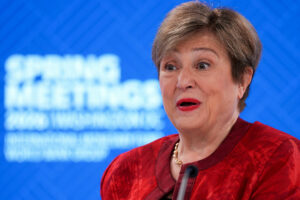
At a press briefing during the IMF-World Bank Spring Meetings on Wednesday, IMF Managing Director Kristalina Georgieva said the war’s impact on Association of Southeast Asian Nations (ASEAN) member economies is unequal, with energy importers like the Philippines taking more toll.
“For the energy importers, those that have very little to none energy reserves of oil and gas, the situation is much more difficult,” Ms. Georgieva said. “And I very much sympathize with the people in the Philippines because I know that your country does face that difficulty.”
In its latest World Economic Outlook (WEO), the IMF slashed its 2026 gross domestic product (GDP) growth forecast for the Philippines to 4.1% from 5.6% in January, reflecting weaker-than-expected growth in 2025 and the impact of the war in the Middle East.
The IMF also expects 4.1% growth for the ASEAN-5 region, which is comprised of Indonesia, Malaysia, the Philippines, Singapore and Thailand, this year. It was marginally slower than its 4.2% estimate in January.
Ms. Georgieva noted that the region is “in a bright spot in terms of growth and economic dynamism” but must still strengthen its regional integration to better weather shocks from the war.
“Actually, ASEAN is a bright spot in terms of growth and in terms of economic dynamism,” she said. “When you look at the impact of this shock, because of this strong buildup over the years, ASEAN is actually weathering the shock as a group of countries relatively well.”
Several ASEAN energy exporters may be better positioned to weather these shocks, in contrast to the heavier impact experienced by energy importers in the region, the IMF chief said.
In the Philippines, oil prices have soared since the United States and Israel’s attacks on Iran on Feb. 28. This week saw the first rollback in pump prices, as global oil prices fell amid the temporary ceasefire in the Middle East.
The Philippines is currently under a national state of energy emergency, which President Ferdinand R. Marcos, Jr. announced last month after noting the threats to the country’s energy supply as the war drags on.
PAUSE
In a separate blog published on Thursday, the IMF said the Philippine central bank can stand pat for now to preserve easing space.
“In economies where inflation remains below target, such as Thailand and the Philippines, further rate cuts can be paused to preserve room for easing later,” IMF Asia and Pacific Department Deputy Division Chief Andrea Pescatori and Director Krishna Srinivasan said.
Philippine inflation accelerated to 4.1% in March, breaking the nearly two-year streak of it settling below the Bangko Sentral ng Pilipinas’ (BSP) 2%-4% target.
Before this, the BSP had held its rates steady in an off-cycle meeting even though it raised its full-year inflation projection to 5.1% from 3.6%, as it noted that immediate tightening risks delaying the economy’s rebound.
This paused the central bank’s easing cycle, which began in August 2024, where it delivered a total of 225 basis points in cuts to bring the policy rate to 4.25%.
BSP Governor Eli M. Remolona, Jr. on Tuesday told BusinessWorld that the expected economic relief from the government’s ongoing fiscal reforms has opened space for monetary policy tightening.
However, he noted that the central bank is still monitoring incoming data, particularly inflation, for clearer guidance for its upcoming policy review on April 23.
REGIONAL SHOCKS
Meanwhile, Asia’s resilience against last year’s US tariff policies and global trade uncertainty will be shaken as the Middle East conflict stokes inflation, weakens external balances and limits policy options, Mr. Pescatori and Mr. Srinivasan said in the IMF blog.
“Asia entered 2026 on a strong footing,” they said. “Despite the region bearing the brunt of US tariffs last April and persistent trade policy uncertainty, growth was resilient in 2025 and trade remained robust.”
“Now, the war in the Middle East and the ensuing energy supply shock are raising inflation, weakening external balances, and narrowing policy options, underscoring the region’s dependence on imported oil and gas,” they added.
The multilateral lender sees Asia expanding slower at 4.4% this year and 4.2% next year from 5% in 2025.
“Should the shock persist or intensify, as in the WEO’s adverse and severe scenarios, growth through 2027 could be reduced cumulatively by 1% to 2%,” Mr. Pescatori and Mr. Srinivasan added.
Inflation in the region is also expected to quicken to 2.6% by yearend, before easing to 2.4% in 2027. Still, this is faster than the 1.4% clip recorded last year.
“The war introduced a new and more immediate headwind clouding the near-term outlook for Asia, where net oil and gas imports equal about 2.5% of economic output,” the blog read.
Amid this, Ms. Georgieva said the crisis calls for a stronger regional integration among ASEAN countries as it faces shared economic woes.
“The Philippines is now leading the ASEAN. I am going to be there when the meeting takes place,” she said. “And I do believe that this is very important for regions that have the potential to trade more within the countries of the region.”
“Build that integration. You will benefit from it in a more shock-prone world,” Ms. Georgieva added.
previous post
